Smartphone Features Explained: AMOLED, 120Hz, RAM, UFS, OIS, Processors & More
Smartphone Features Explained: If you go to buy a smartphone today, then simply looking at the camera megapixels and processor is not enough. While buying a smartphone, it is also important to look at the display type, RAM type, storage type, how many nanometers the processor is built on, which camera sensor is used, and all these other things as well.
But not everyone has knowledge about all these technical things, which is why in this guide, I will explain the important features of smartphones to you in a simple way, so that when you go to purchase a phone, you do not face any difficulty in understanding the specifications.
While buying a smartphone, you should keep these things in mind.
1. AMOLED vs OLED vs LCD: What Is the Difference?
The display is one of the most important parts of a smartphone because we do almost everything on the display.
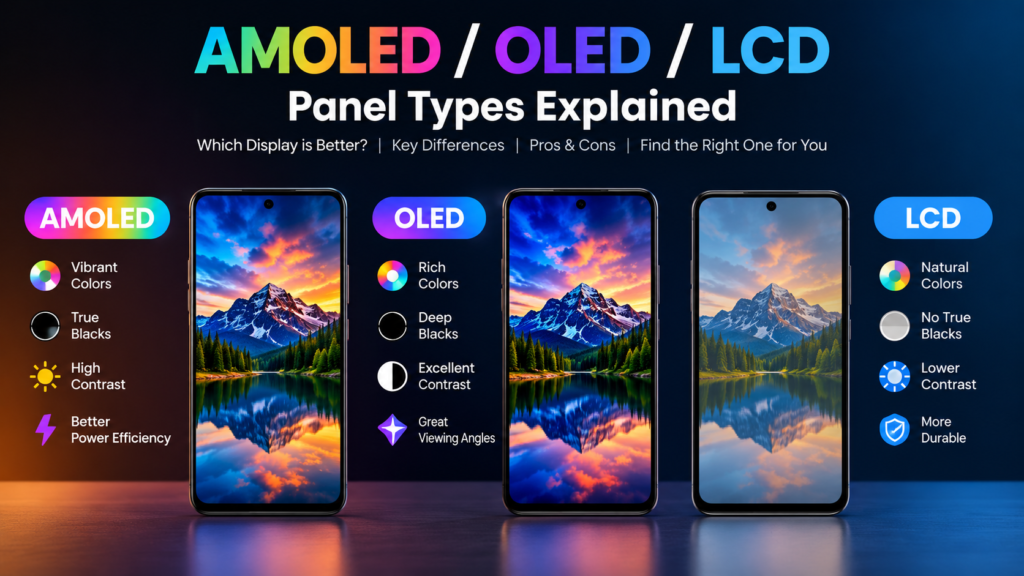
1. What is AMOLED?
- The full form of AMOLED is Active Matrix Organic Light-Emitting Diode. In an AMOLED display, each pixel produces its own light, so it does not need a separate backlight like older LCD displays. In an AMOLED display, we get deep blacks, high contrast, and vibrant colors. Also, using a black theme or wallpaper on an AMOLED display uses much less battery.
2. What is OLED?
- The full form of OLED is Organic Light-Emitting Diode. In this, the display’s individual pixels emit light. AMOLED can be considered an active matrix implementation of OLED technology. In smartphone specifications, manufacturers use different terms such as AMOLED, OLED, and Super AMOLED.
3. What is LCD?
- The full form of LCD is Liquid Crystal Display. An LCD panel uses a backlight to produce images, which is why an LCD display phone consumes more battery.
AMOLED vs OLED vs LCD
| Features | AMOLED | OLED | LCD |
| Self-emissive pixels | Yes | Yes | No |
| Backlight | No | No | Yes |
| Black levels | Excellent | Excellent | Generally lower |
| Common smartphone use | High | High | Common in budget devices |
| Power efficiency | Can be excellent | Can be excellent | Depends on implementation |
| Contrast | High | High | Generally lower |
My verdict: If you watch a lot of movies/web series and want the best experience, then you can choose phones with AMOLED/OLED displays. But if your budget is low, then you can choose a phone with an LCD display.
2. What Is a 120Hz Refresh Rate?
- 60Hz = 60 refreshes per second
- 90Hz = 90 refreshes per second
- 120Hz = 120 refreshes per second
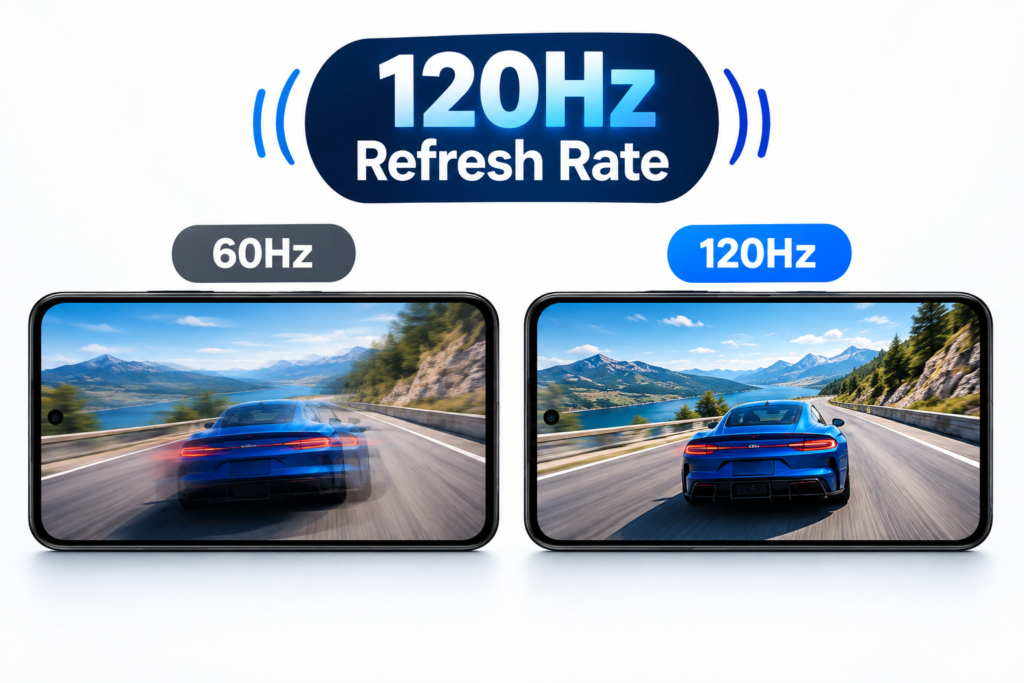
Refresh rate tells you how many times your phone’s display refreshes images in one second. Therefore, a 120Hz display is better than a 60Hz display in terms of scrolling, animations, and smoothness.
Is 120Hz Refresh Rate Necessary?
A 120Hz refresh rate is not necessary for everyone. If you only use your phone for social media scrolling, web browsing, and watching movies, you will feel the smoothness of 120Hz, but at the same time, battery consumption also increases. However, smartphones available today come with settings like adaptive refresh rate, so users can switch between 60Hz, 90Hz, and 120Hz according to their work.
My verdict: Although a 120Hz display provides a smoother experience than 60Hz, the overall performance of a phone is not determined by its refresh rate.
3. LPDDR4X vs LPDDR5 RAM: What Is the Difference?
RAM is used in smartphones to temporarily hold active apps and data. However, simply checking whether a smartphone has 8GB or 12GB of RAM is not enough; it is also important to consider the RAM generation and technology.
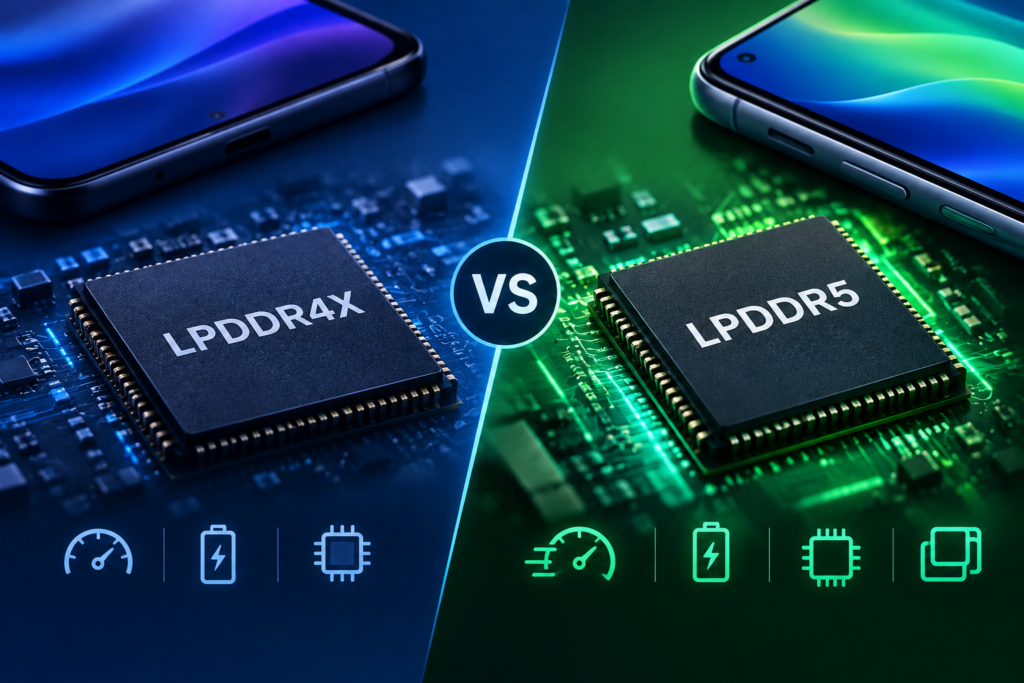
1. What is LPDDR4X RAM?
LPDDR4X RAM is a low-power memory technology that was widely used in earlier smartphones. Even today, LPDDR4X RAM is still used in low-budget smartphones available in the market.
2. What is LPDDR5X RAM?
LPDDR5X RAM is a newer-generation mobile memory technology. This type of RAM is used in expensive smartphones, and gaming smartphones also use LPDDR5X RAM to improve performance and power efficiency.
LPDDR4X vs LPDDR5
| Feature | LPDDR4X | LPDDR5X |
| Generation | Older | Latest |
| Performance | Good | Generally higher |
| power efficiency | Good | improved |
My verdict: LPDDR5X is generally newer and faster memory than LPDDR4X. However, in the real world, a smartphone’s overall performance is not determined by RAM alone. Software optimization, storage type, and the processor also play a major role.
4. UFS 2.2 vs UFS 3.1 vs UFS 4.0
UFS stands for Universal Flash Storage. It is used as internal storage in smartphones. UFS also has different types. Let me tell you about them.
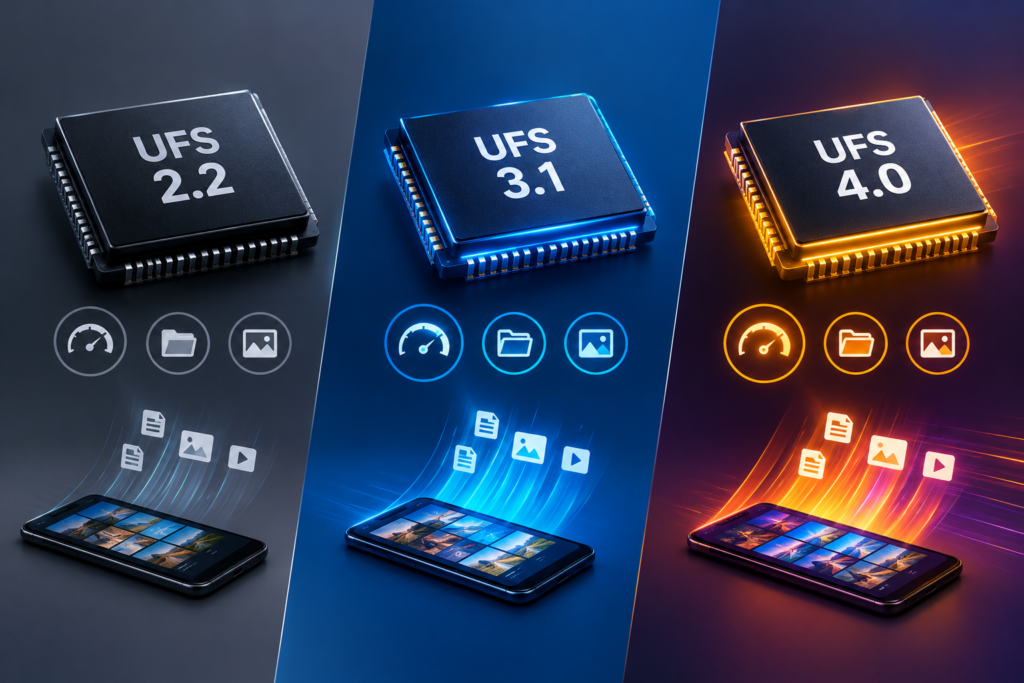
1.UFS 2.2
UFS 2.2 is an older storage type, and it is used in budget-range smartphones. According to today’s usage standards, this type of storage is considered quite slow.
2.UFS 3.1
UFS 3.1 storage is considerably faster and more efficient compared to UFS 2.2, and it is used in mid-range smartphones.
3.UFS 4.0
UFS 4.0 is a newer storage technology that is used in flagship smartphones. Compared to the previous generation, it is more powerful and power-efficient.
UFS Comparison
| Storage Type | Generation | Overall Performance |
| UFS 2.2 | Older | Basic/Good |
| UFS 3.1 | Newer | Fast |
| UFS 4.0 | Newer | Very Fast |
My verdict: Normally, UFS 4.0 > UFS 3.1 > UFS 2.2. All of these storage types are good in their respective price ranges, but a phone’s overall performance does not depend only on the UFS version.
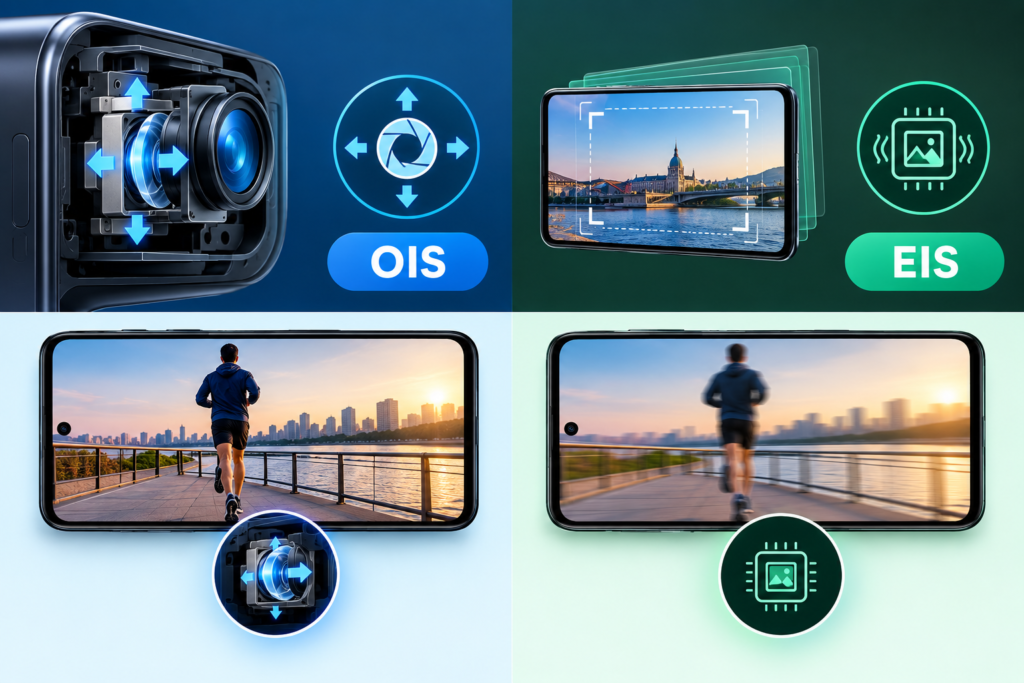
5. What is the difference between OIS and EIS?
Camera stabilization is a very important feature in smartphones, but no consumer pays attention to it.
1.What is OIS?
OIS stands for Optical Image Stabilization. In a smartphone camera, OIS is a physical hardware component. It is used for low-light photography, and when you record a video, its stabilization depends on OIS.
2.What is EIS?
EIS stands for Electronic Image Stabilization. It is not a physical component; EIS uses software-based processing to stabilize videos and images. However, since it is not OIS, it is used in low-budget smartphones.
| Feature | OIS | EIS |
| Full form | Optical Image Stabilization | Electronic Image Stabilization |
| Method | Hardware-based | Software-based |
| Low-light photography | Helpful | Limited compared with OIS |
| Video stabilization | Helpful | Normal |
My verdict: OIS and EIS both work differently. So, when you go to buy a smartphone, especially an expensive one, instead of looking only at the megapixels, you should also check whether OIS is available or not.
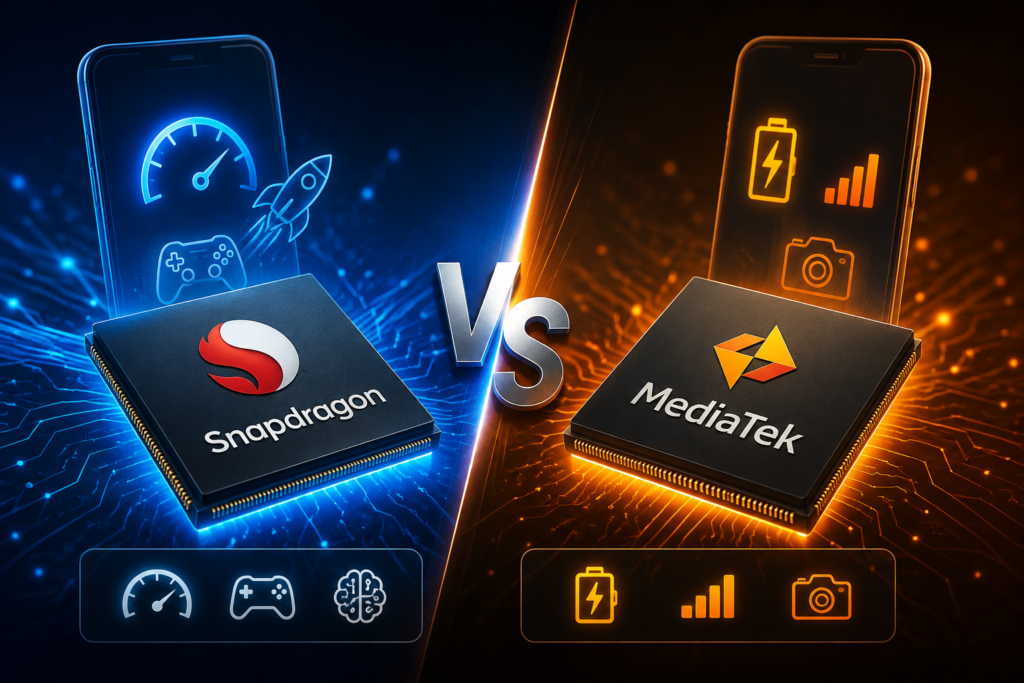
6. Which processor is better: Snapdragon or MediaTek?
- Both Snapdragon and MediaTek make chipsets for smartphones, so we cannot say that all the processors from one company are the best.
- The right way to compare processors would be to compare two phones from the same price range, where one phone uses a Snapdragon chipset and the other uses a MediaTek chipset. This would be the correct way to compare them.
- It would not be right to compare a mid-range Snapdragon chipset with a flagship MediaTek chipset.
What should you look for when buying a smartphone with a good processor?
- CPU performance
- GPU performance
- Manufacturing process
- AI/NPU capabilities
- Camera/ISP capabilities
- 5G modem
- Power efficiency
- Thermal performance
- Real-world benchmarks
My verdict: Neither Snapdragon nor MediaTek is a universal winner, but it would be better to compare these two processors within the same price range.
Final Overview: In this article, I have covered Smartphone Features Explained in detail, including RAM types, storage, processors, OIS, EIS, display types, refresh rates, and much more. If you want to learn about any other smartphone-related topic, feel free to comment below. I’ll bring you a detailed and helpful article on that topic.
Frequently Asked Questions (FAQs)
1.What is the difference between IPS LCD and AMOLED?
IPS LCD vs AMOLED: AMOLED offers deeper blacks, higher contrast, and better picture quality, while IPS LCD is generally more affordable and can provide good brightness and durability. For better display quality, AMOLED is usually the better choice. Click For More Details
2.Which is better: MediaTek or Snapdragon?
MediaTek vs Snapdragon: Neither is universally better. The best choice depends on the specific chipset, performance, power efficiency, and price range of the smartphone.
3.What is the difference between OIS and EIS?
OIS vs EIS: OIS uses physical hardware to stabilize the camera, while EIS uses software-based processing to reduce camera shake and improve video stabilization.
If you want to know which smartphones offer the best value-for-money experience under ₹40,000, you can check out my article, where I’ve also covered Smartphone Features Explained to help you make the right choice. You won’t be disappointed!